- A Telegram CRM is not a contact list. It is three jobs in one place: capture every reply (Live Inbox), qualify and score it (AI), and move it through stages (pipeline).
- In TG:ON this lives inside the same parse→send→reply pipeline. The lead object exists from the moment you parse the chat — no CSV export, no webhook gluing five tools together.
- We are honest: this is a lightweight pipeline CRM, not a Salesforce-class platform. No custom objects, no forecasting dashboards. It triages and advances the replies your outreach produces.
- Local-first. Lead DB, account sessions, and LLM API keys live in local SQLite on your own machine — Windows and macOS desktop app, not a cloud account.
- The AI Qualifier and Closer run on any LLM (OpenAI, Anthropic, Gemini, DeepSeek, Groq) with your own keys.
- Free trial: 3 days or 100 messages, no card. Tiers: Starter $49 (up to 5 accounts), Pro $89 (up to 25), Agency $169 (up to 250).
Most people who run Telegram outreach hit the same wall on week two: the sending works, but the replies are a mess. A few dozen "interested?", "how much?", and "stop messaging me" land scattered across three accounts, and there is no single place to see who is a real lead, who already got a follow-up, and who went cold. The campaign produced demand and then dropped it on the floor.
That is the gap a Telegram CRM fills. Not a generic sales CRM you connect to Telegram with duct tape, but a system that lives where the conversations happen: it collects every inbound reply, scores and tags each lead, and pushes it through a pipeline. This article covers four things — the Live Inbox, AI qualification, lead stages, and where the data lives — plus an honest take on what a "CRM" inside an outreach tool can and cannot be.
The Live Inbox: every reply, one screen
The Live Inbox is the part that makes this a CRM instead of a fancy sender. When a prospect replies to any of your accounts, the message is pulled into one unified inbox — not buried in the Telegram app on whichever account happened to send it. Each conversation becomes a lead record with a stage, an AI score, and the full history of what you sent and what came back.
It keeps attribution. Because the lead object already exists from the parse step, the inbox knows which campaign produced the reply, which of your accounts received it, and which parsed chat the person came from. That context is exactly what a Zapier-to-CRM bridge throws away — more on that in section 03.
You answer from the right account. When you reply, it goes out through the same account that originally messaged the lead, on its own proxy, under the same anti-ban discipline as the campaign. No copy-pasting between the CRM tab and the Telegram client, and no accidentally answering a lead from an account that never spoke to them. The mechanics of why responses must respect account rotation and warmup are covered in the insider pipeline breakdown.
Inbox, not autopilot. The Live Inbox does not silently message strangers on your behalf. It collects replies to outreach you already sent and gives you (or an AI agent you supervise) one place to handle them. Outbound still respects Telegram ToS and anti-ban discipline — capturing replies is the safe half of the loop.
AI qualification: tag, score, advance
Capturing replies is only useful if you can triage them fast. That is the job of the two AI agents — the Qualifier and the Closer — and they run on any LLM you connect: OpenAI, Anthropic, Gemini, DeepSeek, or Groq. You paste your own API key, it stays local on your machine, and you decide the model and the spend.
Qualifier. When a reply arrives, the Qualifier reads it in context and assigns a tag and a lead score — hot, warm, cold, objection, off-topic, opt-out. A "how much per month?" gets scored and surfaced; a "wrong number" gets quietly filed so it never wastes your attention. You stop reading every message just to find the three that matter.
Closer. For leads worth advancing, the Closer drafts (or, if you let it, sends) the next step: answer the price question, book the call, handle the common objection. It writes in the voice you configured and pulls from the same conversation history, so the follow-up is not a generic blast. The full design of these agents is in the AI agents deep-dive, and the standalone landing for the feature is the Telegram AI agent page.
AI scoring is a co-pilot, not a guarantee. An LLM can mislabel sarcasm or a terse "ok". Use the score to prioritize your inbox, not to fully automate replies to strangers. Auto-sending Closer messages at volume re-introduces the same spam-pattern risk as the original campaign — the same USER_BANNED_IN_CHANNEL / @SpamBot account-level restriction we break down in the SpamBot signals article. Keep a human in the loop on anything sent at scale.
Pipeline CRM vs. Telegram + Zapier + a generic CRM
The common way to "add a CRM to Telegram" is a bridge: a bot or webhook fires into HubSpot, Pipedrive, or a Notion database through Zapier whenever a reply happens. It looks tidy in a demo. It falls apart in production for one structural reason — the bridge only knows about the reply, not the campaign that caused it.
| What you need | Telegram + Zapier + generic CRM | TG:ON pipeline CRM |
|---|---|---|
| Lead record origin | Created after a reply fires a webhook | Exists from the parse step, before send |
| Campaign / account attribution | Usually lost — bridge sees text only | Kept — campaign, account, source chat |
| Reply back to the lead | Manual, often from the wrong account | Same account, same proxy, in-app |
| AI scoring | A second add-on + more wiring | Built-in Qualifier / Closer, your LLM key |
| Where lead data lives | Vendor cloud(s) + Zapier history | Local SQLite, your machine |
| Cost / month | CRM + Zapier + AI add-on stack | from $49 (Starter) · Pro $89 |
This is the same "five disconnected tools" problem we map out in the all-in-one breakdown: a parser SaaS, a sender, a CRM, an AI add-on, and Zapier holding them together, all reconciling the same lead in four places. The pipeline CRM collapses that — the lead is one object, and parser, sender, inbox, and AI all write to it directly.
Where the data lives is the other half. With a Zapier stack your prospect list and conversations sit on several vendor clouds. With TG:ON they are local-first — the why and the trade-offs are covered in the local-first piece.
What it is — and what it is not
Let's draw the line clearly so nobody is sold the wrong thing. TG:ON is a lightweight pipeline CRM built for Telegram outreach. It is excellent at the narrow job of turning a cold-outreach campaign's replies into qualified, staged leads you can act on. It is not a Salesforce- or HubSpot-class platform, and pretending otherwise would be dishonest.
Use it for: capturing replies from Telegram cold DM and group outreach, AI-scoring and tagging those leads, advancing them through a few stages (new → qualified → in conversation → won/lost), and replying from the right account — all in one app, with data on your machine. This is the front of the funnel for affiliate, CPA, and agency operators who live in Telegram.
What it does not do: custom objects, deal forecasting, multi-team permission matrices, invoicing, SQL-grade reporting, or a marketplace of third-party integrations. If your sales motion needs those, keep your heavy CRM and let TG:ON feed it the qualified leads. The two are complementary — TG:ON owns the Telegram surface and the conversation; your big CRM owns long-term account management. If you mainly need the outbound half, the cold DM and lead generation pages cover that, and the whole five-function stack is summarized on the marketing software overview.
One more honest note for affiliate and CPA marketers, a core TG:ON segment: a CRM that makes follow-up effortless can tempt you to over-send. Volume still triggers @SpamBot the same way it always did. More accounts spread the load, but each account still needs warmup and limits — there is no immunity, only discipline, as we argue in the warmup myth piece.
Pricing and how to try it
Start free. The trial is 3 days or 100 messages, whichever comes first, no credit card. That is enough to run a real loop end to end: parse a niche, send a small campaign, watch the replies land in the Live Inbox, and let the AI Qualifier score them. The three paid tiers differ mainly by how many Telegram accounts you can run:
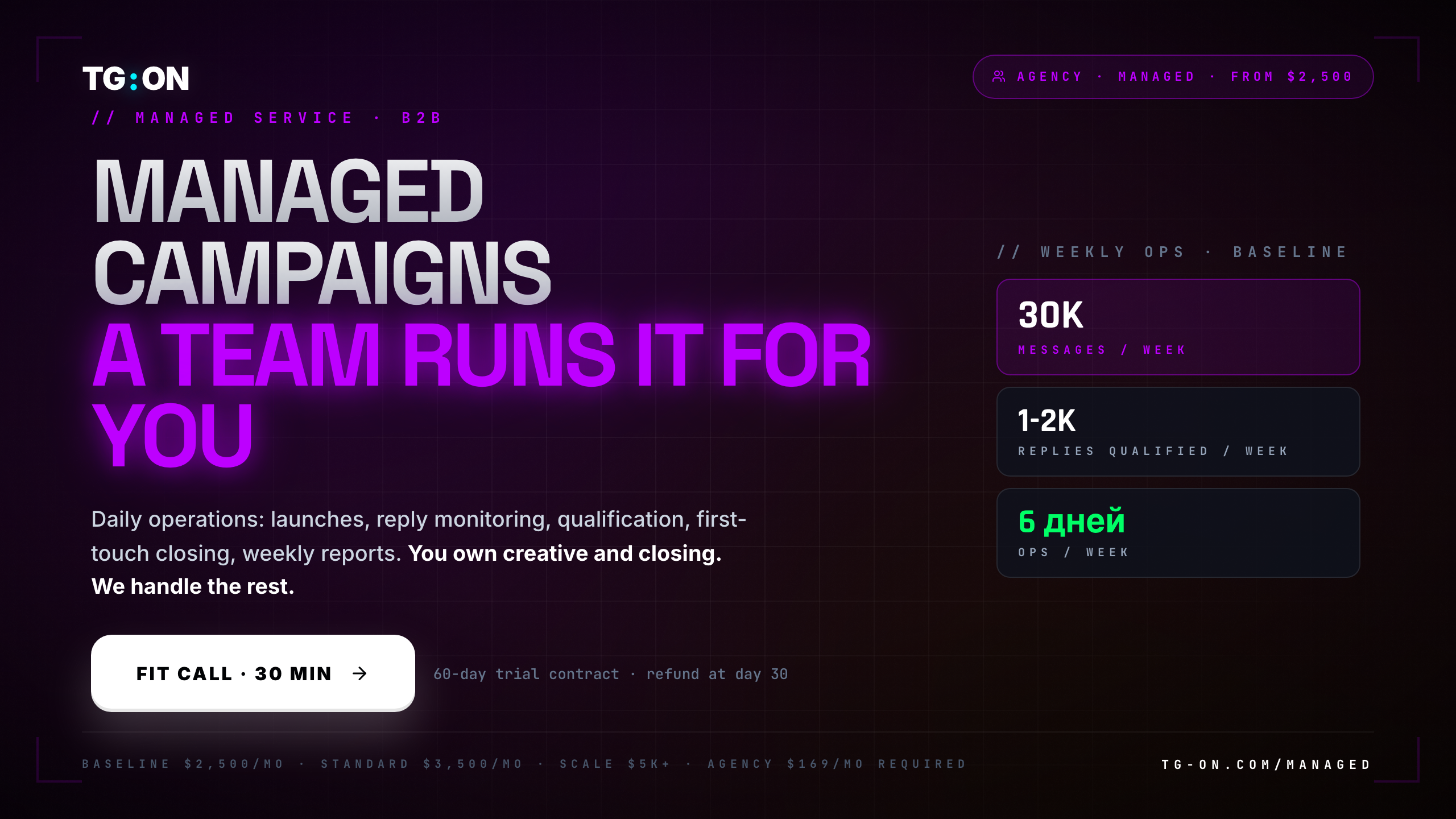
Every tier includes the full pipeline — parser/Vault, mass sender, auto-invite, warmup, the AI editor, and the Live Inbox with AI agents. You are paying for account capacity, not unlocking features one at a time. The full ladder is laid out in the tiers and scale article, and managed-campaign options for agencies are on the managed campaigns page.
TG:ON for Windows and macOS
A local-first desktop app. Sessions, lead DB, and LLM keys stay on your machine. 3-day trial, 100 messages, no card.
Download freeCapture, score, and advance
every Telegram lead — in one app.
3-day / 100-message trial, no card. Live Inbox, AI Qualifier and Closer, and a Vault of 2.9M+ chats and channels inside. Questions go to @tgon_support_bot.
Start the trialFrequently asked questions
Is TG:ON a real CRM or just an inbox?
It is a lightweight pipeline CRM, not a Salesforce-class platform. Every reply lands in a Live Inbox, each conversation is a lead record with a stage and an AI score, and the AI Qualifier and Closer advance those leads. There are no custom objects, no SQL-grade reporting, and no third-party app marketplace. If you run cold outreach in Telegram and need to triage and advance the replies it produces, that is exactly what it does. If you need finance integrations and forecasting dashboards, keep your heavy CRM and use TG:ON as the front of the funnel.
How is this different from connecting Telegram to a CRM with Zapier?
A Zapier bridge sends a webhook to a generic CRM after a reply happens — but it has no idea which campaign, which account, or which parsed chat produced that lead, and it cannot send the next message back through the same account. In TG:ON the lead object already exists from the moment you parsed the chat. Parser, sender, inbox, and AI scoring all write to one record, so there is no CSV export, no webhook lag, and no broken account attribution between steps.
Where is my lead data stored?
Locally. TG:ON is a local-first desktop app for Windows and macOS. Account sessions, the lead database, and your LLM API keys all live in a local SQLite database on your own machine — not in someone else's cloud. That means your prospect list and conversations are not sitting on a vendor's server, and your pipeline does not stall if that vendor has downtime.
Which AI model powers the Qualifier and Closer?
Any of them. The AI agents run on any LLM you connect — OpenAI, Anthropic, Gemini, DeepSeek, or Groq. You paste your own API key, it is stored locally, and you control the model and the cost. The Qualifier scores and tags incoming replies; the Closer drafts or sends the next step to advance the lead through your stages.
How much does it cost and is there a free trial?
The free trial is 3 days or 100 messages, whichever comes first, with no credit card. After that there are three tiers that differ mainly by how many Telegram accounts you can run: Starter is $49 a month for up to 5 accounts, Pro is $89 a month for up to 25 accounts, and Agency is $169 a month for up to 250 accounts. Download from tg-on.com.