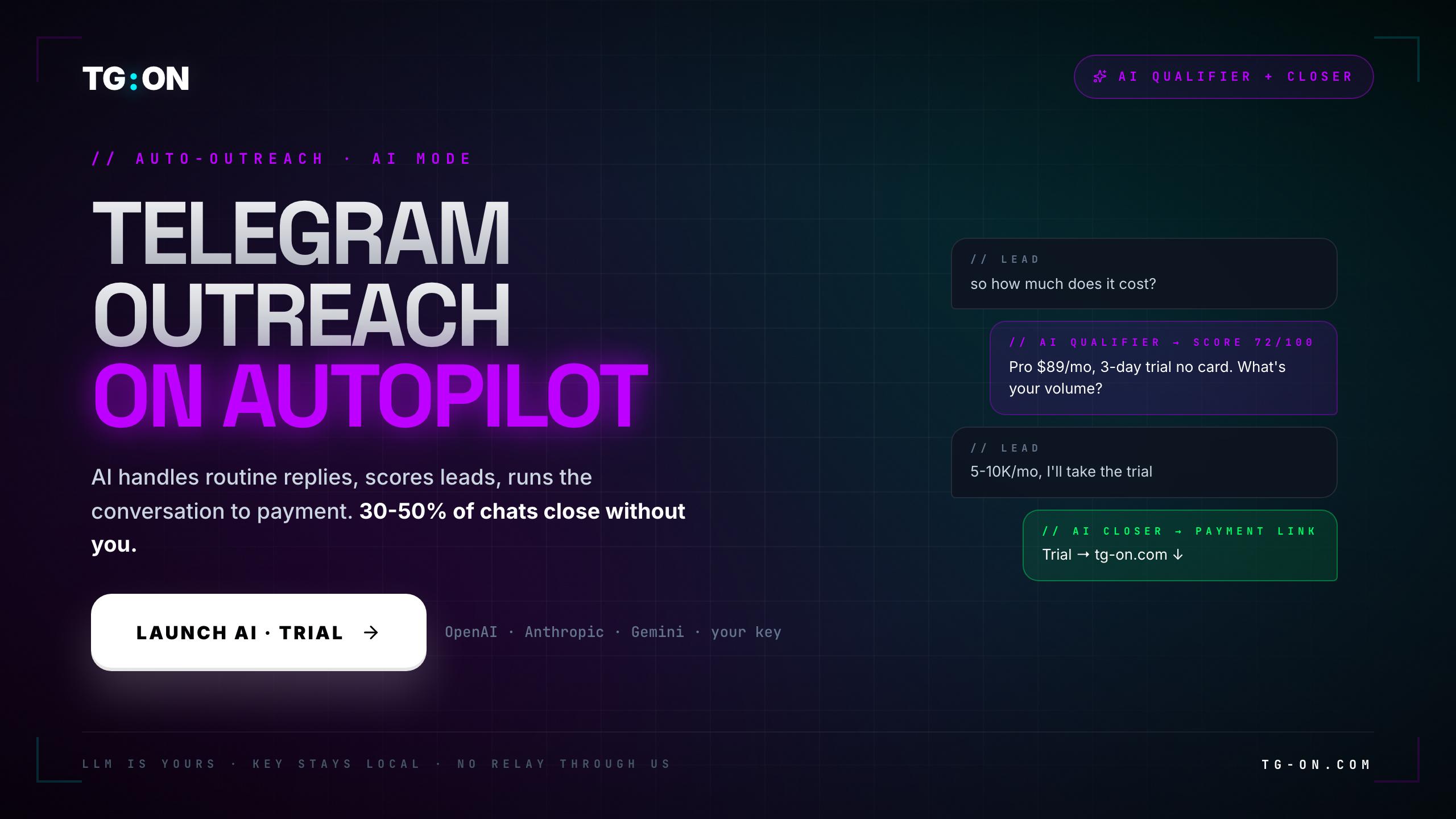
- A Telegram AI agent in TG:ON is not a chatbot. It handles inbound replies to your outreach: a Qualifier scores leads, a Closer drives them toward your goal.
- The agents run on any LLM you bring — OpenAI, Anthropic, Gemini, DeepSeek or Groq. You paste your own key, you pay the model provider directly.
- API keys are stored locally on your machine in local SQLite. No vendor cloud holds your keys, sessions or lead conversations.
- It lives inside the pipeline: parse → send → reply → qualify, on real user accounts — not a separate Bot-API bot strangers have to find.
- Free trial: 3 days or 100 messages, no credit card. Plans: Starter $49, Pro $89, Agency $169 per month. LLM tokens billed separately by your provider.
- The point isn't "an AI that talks." It's one data flow: the same lead record gets parsed, messaged, replied to and scored — no CSV hops between a CRM, a Zapier and a chatbot SaaS.
Search "Telegram AI agent" in 2026 and most results are the same thing: a Bot-API bot you spin up in @BotFather, point at an LLM, and park on a "Message us" button. It answers people who write to it first. That's useful — but it's not what a sales operator actually needs. The bottleneck in Telegram outreach isn't "answer the people who find us." It's "qualify and close the people we already reached."
When you run a real campaign — parse the right chats, send to thousands, replies start trickling in — those replies land in the inbox of the user account that sent the message, not in some bot's chat. A normal chatbot can't touch them. That's the gap TG:ON's AI agents fill: they work on your real accounts, inside the same pipeline that did the sending, and turn raw replies into qualified, moving-toward-the-goal conversations.
Two agents, one job each: qualify, then close
Splitting the work into two narrow agents is deliberate. One generic "answer everything" prompt drifts; two scoped agents stay sharp. Here's the division of labour and the surrounding pipeline they plug into:
The Qualifier. When a reply comes back, the Qualifier reads it in context and scores the lead: is this a real prospect, a tyre-kicker, or noise? It tags the conversation so you (and the Closer) know where to spend energy. This is the agent that saves you from manually triaging hundreds of "ok", "how much?", and "not interested" replies.
The Closer. Once a lead is qualified, the Closer takes over the dialogue and steers it toward the goal you defined — a demo, a link click, a payment, a calendar booking. It works from your instructions and brand voice, not a canned script, and it does it inside the same chat thread on the same account, so the prospect never feels handed off to a bot.
Both agents sit downstream of the insider pipeline that does the parsing and sending. The audience comes from the built-in Vault — 2.9M+ chats and channels with keyword search — so you don't buy a separate parser. One reminder that matters for any outreach: to message as a user you need chats and groups, not channels (only admins can post to channels), so the replies your agents handle come from real group/DM conversations.
Not a Bot-API bot. The whole reason this works is that the agents run on your real user accounts, the same ones that sent the outreach. A @BotFather bot can only see people who started a chat with it — it can never reply to a campaign DM. The AI agent reads and answers in the account's own inbox, which is the only place those leads actually live. More on why native-on-account beats bolt-on bots in our deep-dive on AI agents.
Bring your own LLM — keys stay on your machine
Two things define an AI agent you can trust with sales conversations: whose model it uses and where the keys live. TG:ON answers both in your favour.
Any LLM you bring. The agents aren't locked to one vendor. Paste an API key for OpenAI, Anthropic, Gemini, DeepSeek or Groq and the agent talks to that provider. Want cheaper inference for the Qualifier and a stronger model for the Closer? Use different providers for each. You pay the model provider directly — no marked-up "AI credits" reselling on top.
Keys stored locally. Your API keys, your account sessions and your entire lead conversation history live in a local SQLite database on your own machine — not in a TG:ON cloud. This is the local-first design of the whole app: nothing about your campaign is hostage to a vendor's uptime, and no third party can read the chats your agents are running.
The agent doesn't make you ban-proof. An AI replying to warm inbound is low-risk — those people already messaged you. The ban risk is on the outbound side: cold blasting, no warmup, no delays. USER_BANNED_IN_CHANNEL across many chats is almost always one account hit with an account-level @SpamBot restriction, not a per-group ban or "the AI got flagged." Keep randomized delays, rotation, proxies and gradual warmup on the sender — see how to avoid a Telegram ban.
Generic chatbot vs Bot-API bot vs TG:ON agent
"AI for Telegram" gets sold as three very different things. The difference shows up the moment a real campaign reply lands:
| Capability | Generic SaaS chatbot | @BotFather Bot-API bot | TG:ON AI agent |
|---|---|---|---|
| Runs on | Vendor cloud widget | A bot account | Your real user accounts |
| Can answer outreach replies? | No | No — only people who DM the bot | Yes — the inbox that sent the outreach |
| Lives in the pipeline? | Separate tool, CSV in/out | Separate bot, webhooks | Same parse → send → reply flow |
| Which LLM? | Vendor's, marked-up credits | Whatever you wire up | Any: OpenAI / Anthropic / Gemini / DeepSeek / Groq |
| Where are keys & chats? | Vendor cloud | Your server + bot platform | Local SQLite on your machine |
| Qualify + close roles | One generic prompt | You build it | Two scoped agents: Qualifier + Closer |
The generic chatbot and the Bot-API bot share one fatal limit: neither can see a reply to a campaign DM, because that reply belongs to a user account, not a bot. TG:ON's agents run on that exact account, so the lead that just wrote "how much?" gets scored and answered in the same thread — no export, no webhook glue, no Zapier. This is the same all-in-one logic that removes the five-SaaS stack from the rest of the workflow.
Because the agents are part of the client, not an external service, they speak MTProto correctly and inherit the account's real context. That's also why the sending side handles FLOOD_WAIT and PEER_FLOOD properly instead of guessing — see the bulk sender breakdown for the outbound mechanics that feed these agents.
Where the agents earn their keep
The agents are most valuable wherever inbound reply volume outgrows the human who has to answer it:
Lead-gen agencies run multi-account campaigns where replies pile up across dozens of inboxes; the Qualifier sorts the hot from the noise so a human only touches the leads worth a human. Solo founders and SMM operators use the Closer to keep warm conversations moving when they're asleep or in another timezone. Course and SaaS sellers point the Closer at a single goal — a checkout link or a booked call — and let it handle the repetitive "is this for me?" loop. The full lead-gen flow this sits inside is in our Telegram marketing software guide.
What the agents are not for: pretending to be a different human, scraping channels you can't message, or "adding 10k members overnight" with auto-invite. Invite slowly, under limits, on warmed accounts — the agents handle conversation quality, not magic against Telegram's caps.
How to set it up, and what it costs
Setup is short because there's no cloud to provision. Install the desktop app, connect an account, drop in one LLM API key, and write the two short instruction blocks — one for what counts as a qualified lead, one for the Closer's goal. From there the agents work on every reply your campaign generates.
Five-minute start. Download TG:ON for Windows or macOS → connect a (warmed) account → paste an OpenAI/Anthropic/Gemini/DeepSeek/Groq key → define the Qualifier's "what makes a lead hot" and the Closer's goal → run a small Vault campaign of 20-30 target chats. Your 100-message trial is enough to watch the agents handle real replies, not a demo.
Start free. The trial is 3 days or up to 100 messages, no credit card. After that, three plans — and remember the LLM tokens are billed separately by your own provider, because you bring your own key:
TG:ON for Windows and macOS
Local-first desktop app. Sessions, lead DB and LLM keys stay on your machine. 3-day trial, 100 messages, no credit card.
Download freeQualify and close inbound replies
with AI agents on real accounts.
3-day / 100-message trial, no card. Any LLM, keys stored locally. Vault of 2.9M+ chats and channels inside. Questions → support at @tgon_support_bot.
Start the trialFrequently asked questions
What is a Telegram AI agent, and how is it different from a chatbot?
A chatbot is usually a Bot-API bot that only answers people who message it first. A Telegram AI agent in TG:ON runs on your real user accounts inside the outreach pipeline: it reads inbound replies to your campaign, qualifies the lead (Qualifier) and drives the conversation toward your goal (Closer). It is part of the same parse → send → reply → qualify flow, not a separate bot a stranger has to discover.
Which LLM does the AI agent use, and where do my API keys live?
Any LLM you bring: OpenAI, Anthropic, Gemini, DeepSeek or Groq. You paste your own API key and the agent uses your account. The keys are stored locally on your machine in a local SQLite database, never in a vendor cloud. You pay your model provider directly and can swap providers anytime.
Does the AI agent run as a Bot-API bot or on real accounts?
On real user accounts. The agent handles replies that land in the same inbox your outreach went out from, so the conversation looks like a normal user chat, not a @BotFather bot. That is what lets the same agent live inside the parse → send → reply pipeline instead of bolting a separate chatbot onto it.
Will an AI agent get my accounts banned?
No tool guarantees 100% no-ban. The agent only replies to people who already wrote to you, which is low-risk behavior. The ban risk lives in the outbound side: blasting cold, no warmup, no delays. Keep randomized delays, account rotation, proxies and gradual warmup on the sending side, and let the agent handle the warm inbound conversations.
How much does it cost and is there a free trial?
Free trial: 3 days or 100 messages, no credit card. Plans are Starter $49/mo, Pro $89/mo and Agency $169/mo. The LLM usage is billed separately by your model provider, because you bring your own key. Download for Windows or macOS at tg-on.com.