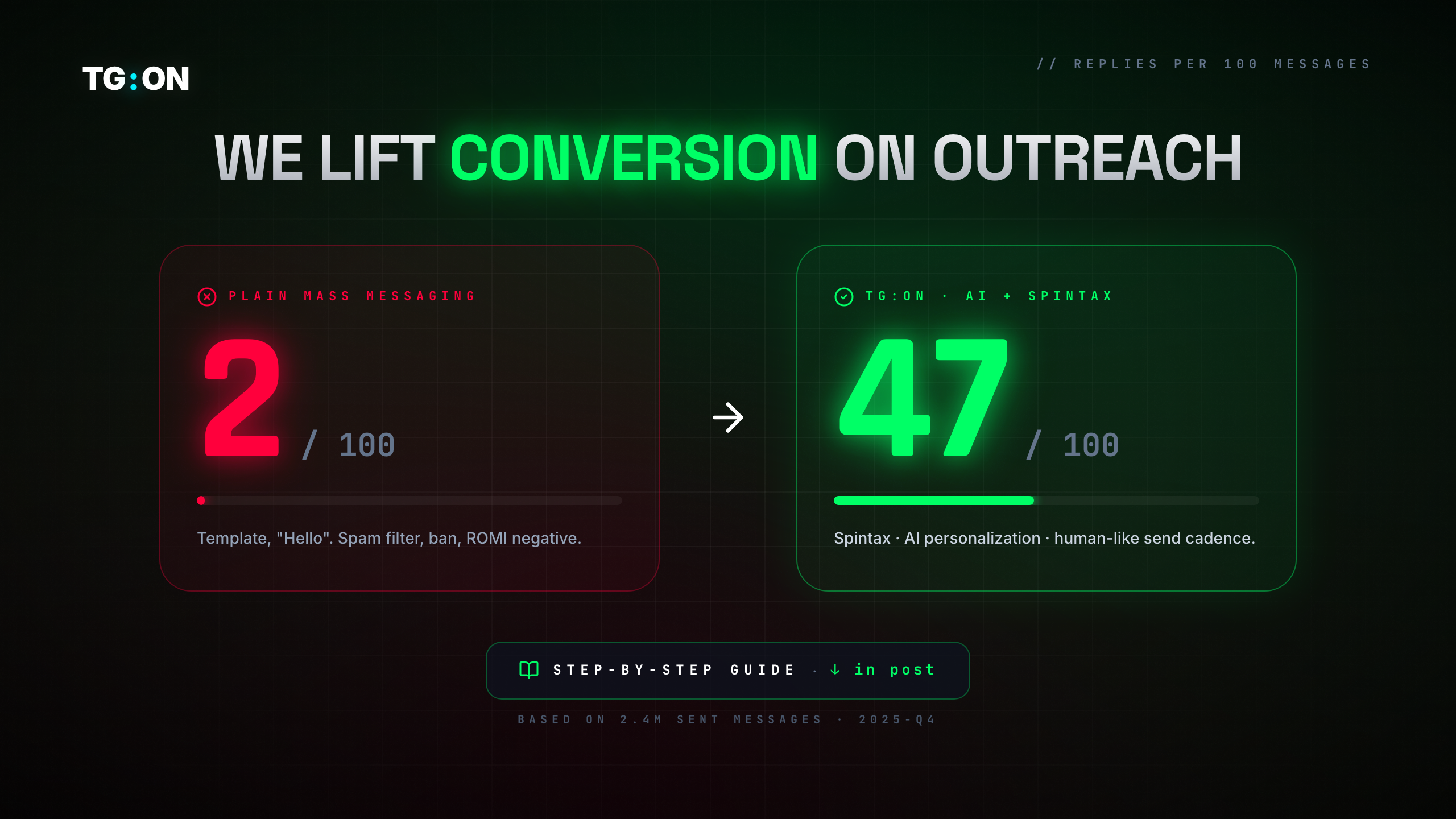
- A cold DM is not a mass blast. The blast sends one identical text to everyone; the cold DM is a personalized 1:1 first message built to earn a reply. Same engine, opposite intent.
- Reply rate beats send count. Relevance + personalization (spintax + AI editor) is what separates outreach from spam — and what keeps accounts alive.
- The honest part: cold DM can violate Telegram's ToS and there is no 100% no-ban guarantee. Anti-ban is behavioral discipline — delays, rotation, proxies, warmup — not a promise.
- TG:ON is a local-first desktop app for Windows and macOS. Sessions, lead DB, and LLM keys stay in local SQLite on your machine.
- One flow, one app: parse → personalize → send → reply → qualify. The Live Inbox collects replies; AI Qualifier/Closer score and advance leads — a lightweight pipeline CRM, not a Salesforce.
- Trial: 3 days / 100 messages, no card. Pricing: Starter $49, Pro $89, Agency $169 per month. Vault: 2.9M+ chats and channels.
Most people who search for "Telegram cold DM" mean one of two very different things. One group wants a button that fires the same message at ten thousand people. The other wants the thing that actually works in 2026: a relevant, personalized first message sent to the right person, in a chat where the topic fits, that earns a real reply. This page is about the second kind — because the first kind is exactly what gets accounts restricted by @SpamBot before the campaign pays for itself.
The distinction matters more than any feature list. A blind blast and a good cold DM can run on the same sender engine, but they are measured by opposite numbers. A blast optimizes for sends; a cold DM optimizes for reply rate. Get personalization and targeting right and you send fewer messages, keep your accounts, and book more conversations. Get them wrong and you burn a warmed account in an afternoon. Let's walk the whole flow — parse, personalize, send, reply, qualify — and stay honest about the risk at every step.
Cold DM vs mass blast: same engine, opposite intent
People conflate these two because the sending mechanics overlap. They shouldn't. The difference is entirely in intent, targeting, and personalization — and that difference is what determines whether you're doing outreach or generating spam complaints.
A mass blast sends one identical message to as many targets as possible. Identical text in a hundred chats within a minute is the textbook spam signature — Telegram's anti-spam reads it in minutes, and the blast burns both the list and the account. Volume is the only metric, and volume is exactly what gets flagged.
A cold DM is the opposite. It's a 1:1 first message that earns a reply: it references the person's niche or the chat they're in, it reads like a human wrote it, and it opens a conversation rather than dumping a pitch. The TG:ON sender supports spintax (text variation so no two messages are the same) and an AI message editor to draft and tighten that first line — so personalization scales without becoming copy-paste. We've broken down why this lifts conversion in the piece on the conversion jump from blast to conversation.
Targeting is the other half. To message as a user you need chats and groups, not channels — only an admin can post to a channel. The built-in Vault holds 2.9M+ chats and channels with keyword search, so you can filter down to the chats where your offer is actually on-topic. How to assemble that database from public sources without crossing ToS lines is covered in the Telegram scraper guide.
Relevance is the cheapest anti-ban tool you have. A message that fits the chat gets replies instead of reports. A message that doesn't fit gets flagged — by both the people in the chat and the system. Targeting the right chats is not just better marketing; it's the single biggest lever on how long your accounts survive.
Parse → personalize → send → reply → qualify
Cold outreach done right is a five-step loop, and in TG:ON it all lives in one app with one lead record — no CSV export between tools. Here is the flow end to end:
| Step | What happens | TG:ON module |
|---|---|---|
| 1. Parse | Find on-topic chats/groups by keyword | Vault (2.9M+ chats and channels) |
| 2. Personalize | Draft a 1:1 first message, vary it | Spintax + AI message editor |
| 3. Send | Deliver under limits, FloodWait-aware | Mass sender (delays, rotation, proxies) |
| 4. Reply | Collect incoming replies in one place | Live Inbox |
| 5. Qualify | Score the lead, advance it to the next stage | AI Qualifier / Closer (any LLM, keys local) |
Parse. Before you write anything, you need an audience that fits. Vault search returns chats and groups by keyword — remember, chats/groups, not broadcast channels, because you're messaging as a user. The result lands straight in the shared database; there is no export step.
Personalize. This is where cold DM diverges hardest from blasting. Spintax rotates phrasings so each message is unique, and the AI editor helps you write a first line that references the recipient's context. Personalization at scale is the whole game — the insider pipeline write-up shows how a relevant opener changes everything downstream.
Send. The sender handles spintax, media, scheduling, and FloodWait natively, and threads volume across accounts with randomized delays and per-account proxies. This is the step where discipline lives or dies — more on that in section 03.
Reply. The built-in Live Inbox collects every reply in one window so nothing slips. Cold DM only works if you actually answer fast; a missed reply is a dead lead.
Qualify. AI agents (Qualifier and Closer) read incoming replies, score the lead, and advance it. They run on any LLM — OpenAI, Anthropic, Gemini, DeepSeek, Groq — with keys stored locally. This is a lightweight pipeline CRM, and we mean lightweight: it scores and advances leads, it is not a Salesforce-class CRM, and we'd rather you know that up front. The full agent breakdown is on the Telegram AI agent page.
Local-first means your pipeline is yours. TG:ON is a desktop app, not a cloud service. Account sessions, the lead database, and your LLM API keys all sit in local SQLite on your disk. You're not handing logins, conversations, or keys to a third party — and your campaign doesn't stall because someone else's uptime did. More on that model in why local-first wins for Telegram.
The honest part: ban risk, ToS, and discipline
Time to be honest, because the rest of the internet won't be. No software gives a 100% no-ban guarantee — anyone who claims one is lying. And unsolicited cold DM can run against Telegram's Terms of Service, full stop. What good software does is make account behavior look human instead of robotic, which lowers the risk substantially — but never to zero. Four mechanisms do the real work:
Randomized delays. Not a fixed pause between messages (that's a pattern too) — randomized intervals. Humans don't send exactly once every ten seconds.
Account rotation. Volume is spread across several accounts instead of dumped on one. One account under restriction is not the whole campaign — but more accounts is not immunity. Each account still needs its own warmup and its own limits.
Proxies. Different accounts send from different IPs, each on its own proxy. A dozen accounts from one address is its own signal to the system.
Warmup. A new or freshly bought account should not fire hundreds of messages on day one. Gradual activity lowers the chance of tripping a flag. What actually works in warmup versus 2022 cargo-cult is dissected in the warmup myth.
How to read the errors. USER_BANNED_IN_CHANNEL is almost never a ban in one specific group — it's an account-level restriction from @SpamBot that surfaces across many chats at once. A hundred of those errors usually means one restricted account, not a hundred bans. What actually trips @SpamBot is reverse-engineered by signal in the SpamBot signals piece, and the risk-management view is in anti-ban as risk arbitrage.
The takeaway: "no ban" is not a property of a button — it's a discipline of settings that the software either helps you keep or doesn't. TG:ON bakes delays, rotation, warmup, and proxies into one process, but your final safety still depends on not cranking limits "to max for speed." Affiliate and CPA marketers are a core part of who uses TG:ON, and the honest framing is the same for everyone: outreach has to respect Telegram's ToS and anti-ban discipline, or the math stops working.
One data stream instead of five exports
The real reason cold DM falls apart at scale isn't the sending — it's the seams between tools. Parse in one SaaS, export a CSV, import into a sender, push replies into a CRM, wire an AI step through Zapier. Half the week goes to reconciling the same lead list across five systems. TG:ON collapses that into a single data stream where the lead object exists exactly once:
This is not "five microservices behind one login." Because the sender is a native MTProto client rather than a wrapper over the Bot API, it handles the protocol correctly — FLOOD_WAIT, PEER_FLOOD, entity caching — which matters enormously for cold DM survival. The all-in-one case against gluing five SaaS together is laid out in the all-in-one breakdown, and the broader product surface lives on the Telegram marketing software page. Volume-side mechanics are on the bulk sender page; the ban-avoidance discipline has its own deep dive in how to avoid a Telegram ban.
Pricing and how to try it
You can start for free. The trial is 3 days or 100 messages, whichever comes first, no credit card. That's enough to run a real cold DM cycle: parse a niche, write a personalized opener, send it, and watch the replies land in the Live Inbox. After that, three tiers — and the tiers differ by how many Telegram accounts you can run, not just by price:
How to start. Download the app for Windows or macOS, connect an account, find 20-30 on-topic chats (not channels) in Vault for your niche, draft a personalized first message with spintax, and send a careful round with the default delays. Then watch the Live Inbox. The 100-message trial is a full test of the reply loop, not a crippled demo. Tier limits and scaling math are on the pricing-by-scale page.
TG:ON for Windows and macOS
Desktop app. Runs locally — sessions and keys stay with you. 3-day trial, 100 messages, no card.
Download freeParse, personalize, send, reply
and qualify — in one app.
Trial 3 days / 100 messages, no card. Vault of 2.9M+ chats and channels inside. Questions go to @tgon_support_bot.
Start the trialFrequently asked questions
Is cold DM on Telegram against the Terms of Service?
Unsolicited bulk messaging can violate Telegram's ToS and trigger anti-spam restrictions, so be honest with yourself about that. The lower-risk path is relevance: message people in chats where your offer is on-topic, send personalized 1:1 first messages instead of identical blasts, keep volume modest per account, and stop the moment replies turn negative. TG:ON gives you the discipline tools, not permission to ignore the rules.
How is a cold DM different from a mass blast?
A blast sends one identical message to everyone and optimizes for volume. A cold DM is a personalized 1:1 first message that earns a reply: it references the person's niche or chat, uses spintax and the AI editor so no two messages read the same, and is built to start a conversation. Same sender engine, opposite intent. The blast burns lists and accounts; the cold DM is measured by reply rate, not send count.
Can TG:ON help my cold DMs get more replies?
Indirectly, yes. Reply rate is driven by targeting and message quality. TG:ON's Vault helps you find on-topic chats (2.9M+ chats and channels), spintax and the AI editor keep first messages personalized and varied, and the Live Inbox plus AI Qualifier/Closer make sure replies actually get answered and scored. TG:ON does not promise a number; it removes the friction that kills reply rates.
Where do my accounts, leads, and API keys live?
Locally. TG:ON is a desktop app for Windows and macOS. Account sessions, your lead database, and your LLM API keys are stored in a local SQLite database on your own machine, not in someone else's cloud. AI agents can run on any LLM (OpenAI, Anthropic, Gemini, DeepSeek, Groq) and the keys never leave your disk.
How much does it cost and is there a free trial?
The free trial is 3 days or 100 messages, whichever comes first, with no credit card. After that: Starter $49/mo (up to 5 Telegram accounts), Pro $89/mo (up to 25 accounts), Agency $169/mo (up to 250 accounts). Download for Windows or macOS at tg-on.com.