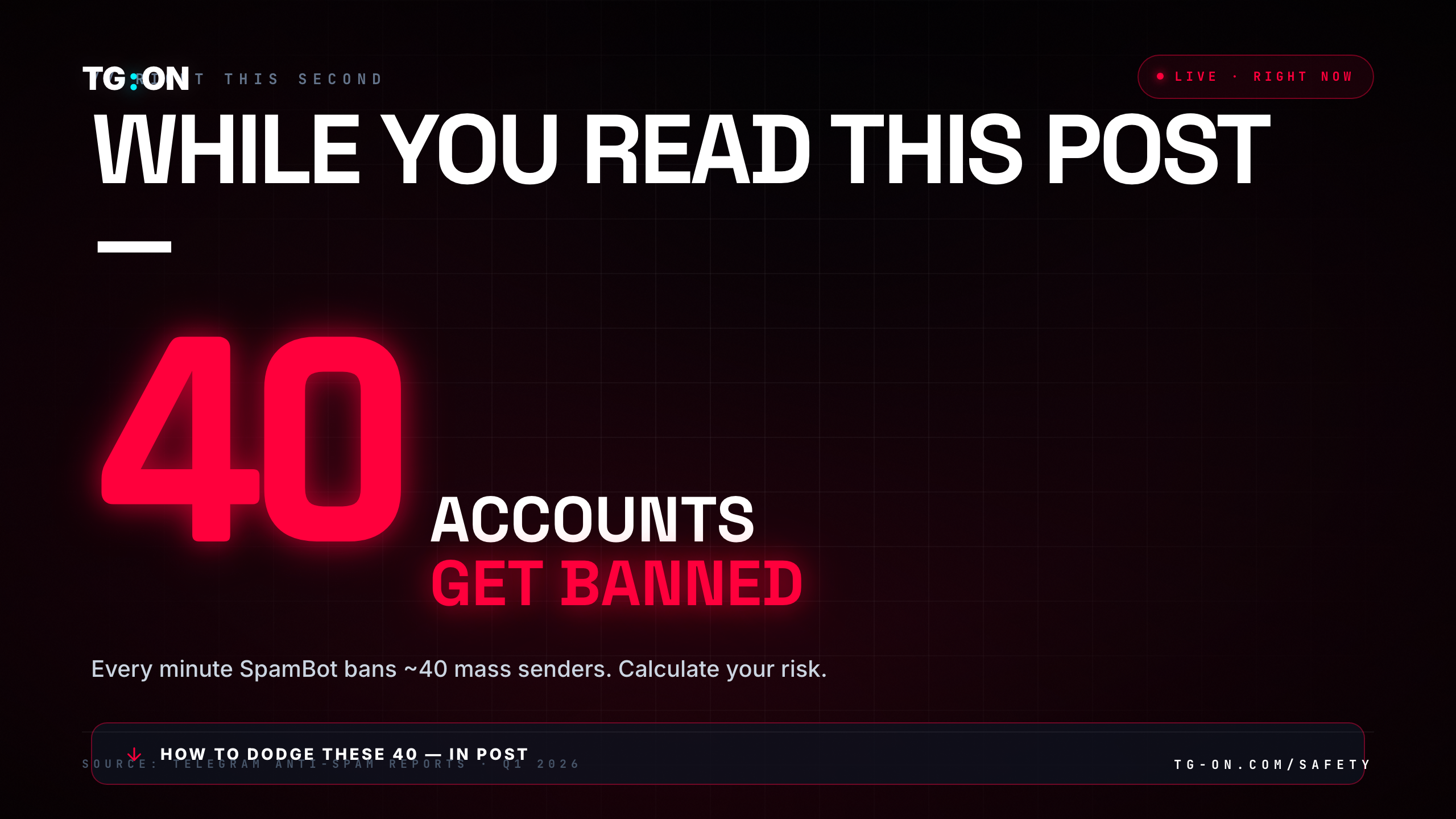
- Estimated ~40 accounts/min banned on Telegram from mass outreach patterns. 57,600/day. 21M/year.
- Based on our observations, 92% of bans fall into 5 categories, each with a specific triggering pattern.
- 34% — DC proxies. 28% — burst sending. 18% — text hash collision. 9% — fingerprint fail. 3% — instant start.
- The remaining 8% — edge cases: recipient complaints, privacy settings, keyword filters, geo mismatch.
- All 5 categories are preventable. You need infrastructure, not "luck".
Telegram doesn't publish official ban statistics. But there are indirect estimates based on:
- Public reports from industry services (Bright Data, Soax, SEON) on detection rates
- Aggregated data from anti-ban solution vendors
- Our own observations of ~1,800 ban events across our client base
The figure ~40 accounts/minute is an estimate, but a plausible one for the active outreach ecosystem. Telegram has 950M+ MAU, and according to various estimates 100-500K accounts are engaged in mass outreach at any given moment. At a detection rate of 5-10%/month, that's 10-50K bans/day, or 7-35 per minute.
5 categories by frequency
| # | Category | % of bans | Mitigation |
|---|---|---|---|
| 1 | DC proxies / no proxy | ~34% | Residential pool |
| 2 | Burst sending (>100 msg/hour) | ~28% | Log-normal rate-limit |
| 3 | Identical text hash | ~18% | Spintax + LLM |
| 4 | Fingerprint collision | ~9% | Per-account unique fingerprint |
| 5 | Instant start + burst | ~3% | 3-5 days of behavioral warmup |
| — | 92% total | Preventable | |
| 6 | User complaints (report spam) | ~5% | Offer quality |
| 7 | Privacy restrictions (recipient blocks) | ~2% | Filter targets |
| 8 | Keyword filters (banned content) | ~1% | Avoid restricted topics |
34% — DC proxies or no proxy
The most common cause — a media buyer tries to save money by buying datacenter proxies ($2-3/month/account) instead of residential ($10-15). Telegram sees the ASN in DC range → priority scan → catches other signals faster.
Another 5-7% in this category — working without any proxy at all, from a single public IP. This is an instant group flag when 5+ accounts run from one IP.
Mitigation: switch to residential proxies via Bright Data / Oxylabs / Soax. Cost $8-15/month/account. Pays off after the first account that doesn't get banned.
28% — Burst sending
When a script sends 100+ messages per hour, Telegram starts with FLOOD_WAIT. After 3-5 of those in a short window — PEER_FLOOD. After a few consecutive PEER_FLOODs — a ban through @SpamBot (if there are complaints) or simply restricted state.
Typical mistakes:
time.sleep(random.randint(2, 5))between messages — too deterministic- Fixed intervals (every 30 seconds) — obvious bot pattern
- Sending all messages at one time slot (14:00 Monday) — batch signature
Mitigation: log-normal rate distribution (median 90s, sigma 0.7). Spread across 3-4 time windows per day. Long "lunch" pauses every 8-12 messages.
18% — Identical text hash
Telegram hashes the body of every message. At 50+ identical hashes in a short period — content cluster flag.
Mitigation: spintax with 4-5 variable blocks + LLM rewriting. Covered in detail in the article on conversion.
9% — Fingerprint collision
50 accounts with identical device_model="Desktop", app_version="4.8.11", system_version="Windows 10" → SpamBot sees a farm.
Mitigation: fingerprint randomization from the real Telegram user population, unique per-account, stable across sessions.
3% — Instant start after SIM activation
Fresh SIM → authorization → outreach begins within 24 hours. A perfect bot profile for Telegram.
Mitigation: 3-5 days of behavioral warmup. Covered in detail in the article on warmup.
8% uncontrollable
The remaining 8% — categories that can't be solved with infrastructure:
- User complaints (5%) — the recipient reports to @SpamBot. Solved at the offer level, not the tooling level.
- Privacy restrictions (2%) — the recipient blocked messages from non-contacts. Not a ban on your account, but an impossible contact.
- Keyword filters (1%) — if the offer contains banned keywords (e.g., specific categories of financial services), Telegram filters it.
These 8% are the natural baseline. You can't eliminate them completely, but you can reduce them: a better offer → fewer complaints; correct targeting → fewer privacy blocks.
TG:ON for macOS · Windows · Linux
Desktop app, 160 MB. Runs locally, your keys stay yours. 3-day trial, no credit card.
Download for free5 categories → 5 TG:ON features.
3-day trial.
Residential proxies, smart rate-limiter, spintax+LLM, unique fingerprints, behavioral warmup. Closes 92% of ban causes with one checkbox.
Start trial