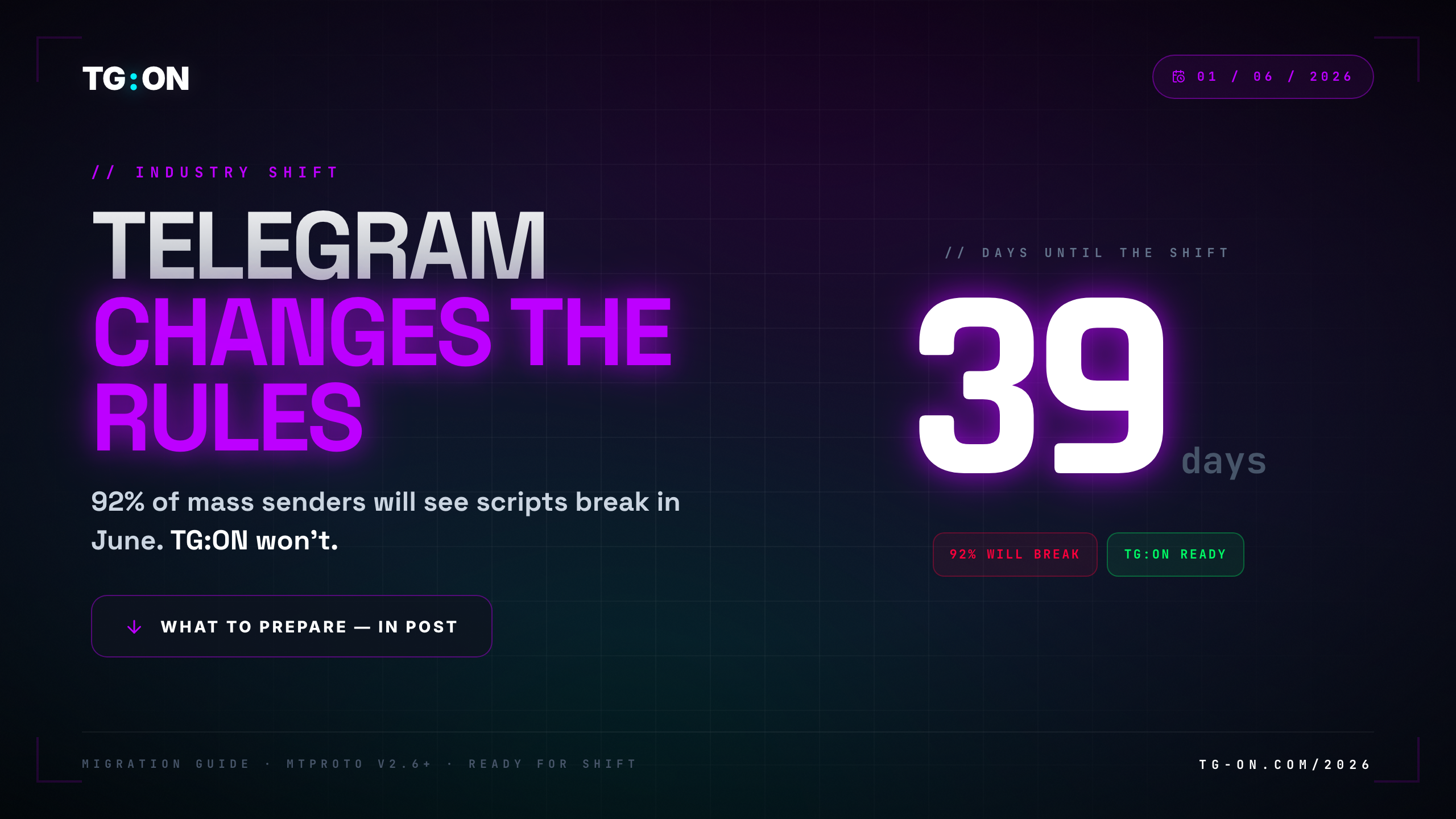
- Telegram is gradually shifting MTProto: new transport flags, session-string encoding changes, rate-limit standardization.
- Most changes are backward compatible, but come with a deprecation window. If you don't migrate in time, your client starts getting warnings, then rejections.
- Key risk zones:
auth.importAuthorizationbeing deprecated, new flood headers, changes tochannels.GetParticipantspagination. - Libraries (telethon / pyrogram) update with a 2-4 week lag after the ANO. If you use your own fork — track it yourself.
- TG:ON updates automatically on the service side — clients don't feel migrations.
Telegram publishes MTProto changes through API Layers. Each layer is an increment: methods are added, some are marked deprecated, schema types change. The current layer (at the time of publication) is ~180.
Most updates are soft. Telegram rarely breaks backward compatibility in a single day. The typical flow: a new method appears → the old one is marked deprecated → the deprecated one keeps working for another 6-12 months → then it's removed.
But in 2026, a major consolidation is expected — several transitions at once, which collectively will make old custom clients unusable. Here's what specifically.
Session-string v2: what's changing
A session-string is a serialized auth key your client uses to log into Telegram without re-authenticating. Historically, different clients used different formats: telethon — pickle+base64, pyrogram — custom binary.
Telegram is moving to a standardized format with backward compatibility. The new format contains:
- Version tag (1 byte) — for future migrations
- DC id + auth_key (256 bytes) — as before
- Device fingerprint metadata — app_version, device_model, system_version are stored in the session-string (not set per-call)
- Creation timestamp — for aging detection
What breaks: clients that used to generate session-strings and pass the fingerprint on every connection now need to embed the fingerprint into the session itself. Otherwise — Telegram returns AUTH_KEY_UNREGISTERED.
New flood headers: more granular rate-limiting
The classic FLOOD_WAIT_X is Telegram's single way to say "hold on". The new scheme introduces differentiated headers:
| Header | What it means | Mitigation |
|---|---|---|
FLOOD_WAIT_X | General rate limit (as before) | Wait X seconds |
FLOOD_PREMIUM_WAIT_X | Limit on actions in a premium context | Apply to premium targets |
FLOOD_PEER_WAIT_X | Limit on messages to a specific peer | Pause for that peer only |
SLOW_MODE_WAIT_X | Restriction in a group with slow mode | Respect group's slow mode |
The split gives Telegram the ability to throttle in a targeted way without blocking the whole account. For clients it means: you need to distinguish FloodWait types and handle them accordingly.
Endpoints on the way out
Based on observed deprecation patterns, the following methods are in the risk zone:
auth.importAuthorization— used to transfer a session between DCs. Being replaced by server-side automatic DC affinity.channels.GetParticipantswith theChannelParticipantsRecentfilter — returned the last N participants. Being replaced bychannels.GetStatisticsfor aggregations.messages.SearchGlobal— global search across all chats. Being tightened — will be available only to Premium accounts.
If you use channels.GetParticipants for scraping, get ready for restrictions. A possible workaround: pull participants through the discussion group (if one exists) or via GetMessageReactionsList.
What to do for clients on telethon / pyrogram
If you have your own fork of a popular Python library:
- Update to latest — the library author usually patches new layers within 1-3 weeks. Follow GitHub releases.
- Migrate session storage — if you cache session-strings in your DB, you'll need to regenerate all sessions under the v2 format.
- Distinguish FloodWait subtypes — instead of a single
except FloodWait, use 3-4 different ones with matching handling. - Log warnings — Telegram often ships non-fatal warnings for deprecated methods. If you don't log them, you'll miss the upcoming deprecation.
If TDLib
Updating TDLib automatically pulls all schema changes. Usually just git pull && rebuild. Session format changes are most often transparent (the library re-encodes in the background).
If SaaS
Ask your vendor: "when is the migration to the new MTProto layer planned?". A normal answer is "already done, clients didn't notice". If the answer is "someday in the future" — red flag.
Why migrations don't worry us
Our MTProto client is written at the level of a custom TDLib fork + our own schema layer. API changes are handled centrally:
- We monitor Telegram's GitHub and core.telegram.org daily
- We beta-test new layers on test accounts 1-2 weeks before prod rollout
- Pushing updates to clients is transparent, via desktop auto-update
- Session storage is on our side — reconversion on first connect
For the user this means: you don't think about MTProto. Telegram changes a layer → you don't notice.
TG:ON for macOS · Windows · Linux
Desktop app, 160 MB. Runs locally, your keys stay yours. 3-day trial, no credit card.
Download for freeMTProto is our problem.
Just use the pipeline.
TG:ON updates automatically. You don't get distracted by session-string v2, new flood headers, or deprecated endpoints. 3-day trial — check the stability.
Start trial