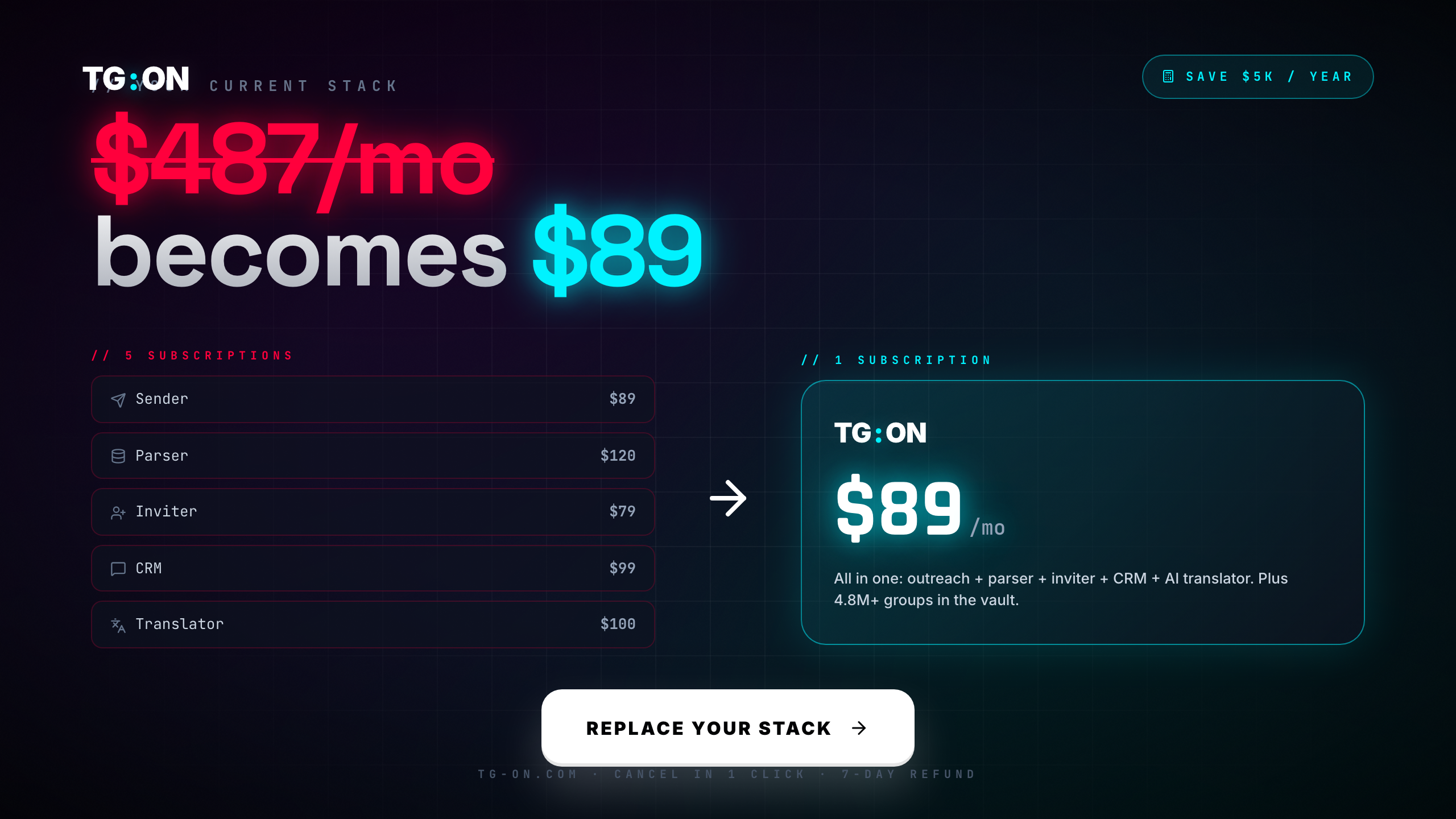
- An average active Telegram operator's 2026 stack: 5 SaaS tools — sender + parser + inviter + CRM + translator. Total: $400-600/mo.
- Direct savings from consolidation: $300-500/mo. Hidden costs (integration time, billing, API sync): another 10-20 hours/mo.
- Bundling has downsides: lock-in, single-vendor risk, "weakest link" — if one module is worse than best-of-breed, you can't swap it.
- When bundling wins: weekly volume > 10K messages, you actually use all 5 functions, UX matters more than point-tool quality.
- When point-tools win: narrow use (only parsing or only CRM), or best-of-breed required for a specific module.
Anyone doing serious Telegram cold outreach at some point assembles a stack of separate tools. First, a parser — became convenient. Then a sender. Then for managing replies — a CRM. Then a translator for international audience. By year-end you have 5 subscriptions and a feeling that this is "normal".
It's not normal. Let's examine the economics of this stack — without marketing, with real market prices.
Telegram automation SaaS in 2026
The market segments into ~6 categories. Each has several players. Average Pro-tier pricing:
| Category | Typical tools | Avg Pro tier |
|---|---|---|
| Sender (mass messaging) | Forward, TeleSender, TGCRM, Sender Turbo | $60-120/mo |
| Parser (audience scraping) | TGScraper, tg-member, TelegaPy | $80-180/mo |
| Inviter (channel auto-invite) | TGInviter, Invitify | $50-100/mo |
| CRM / Inbox | Chatra-TG, UnifiedChat | $80-150/mo |
| Translator | DeepL Pro, GPT plus API | $20-100/mo |
| Proxies (residential) | Bright Data, Oxylabs, Soax | $50-500/mo |
A moderate-load operator (5-20 accounts, 500-5000 messages/week) typically pays: sender $89 + parser $120 + inviter $79 + CRM $99 + translator $100 + proxy $50 = $537/mo. Without proxies — $487.
What you pay besides money
1. Integration overhead
Parser exports CSV → you import to sender. Sender spits out replies → you import to CRM. CRM receives messages in various languages → you use translator. Between them, usually no native API integrations — working via copypaste or homegrown scripts. On average: 5-8 hours/month on stitching processes.
2. Data drift and duplicates
A lead ends up in parser → sender → reply → CRM. But IDs diverge: parser has its own format, sender its own, CRM a third. Duplicates on import. Data loss on export.
3. Telegram API updates
Telegram updates MTProto several times a year. When this happens, each of 5 vendors patches their solution at its own pace. Your parser might run on an old version while sender updated.
4. Billing and subscriptions
5 different invoices, 5 different charges, 5 different renewal dates. Forget one — hello downtime for a week.
Real stack cost: $487 direct + (5-10 hours × $30-50/hour) = $637-987/mo effectively. Time on stitching is your most expensive resource.
Mono-tool economics
When a vendor makes one binary with all functions, they have structural advantages that translate to lower price:
- One deployment — one infrastructure team, one build pipeline. Developers don't split time across 5 codebases.
- Shared core — MTProto client, proxy rotation, rate limiter — written once, used by all modules. 5 separate vendors write this 5 times with varying quality.
- Shared data layer — parser writes to the same DB sender reads from. No serialization/deserialization between processes.
- Unified auth — Telegram user sessions stored in one secret-store, used by all modules without copying.
- No CAC per product — vendor acquires customer once, upsells within product. Reduces sales & marketing budget proportionally.
These reduction effects roll into price. TG:ON Pro $89 is cheaper than any of the 5 point-tools. Only possible because we don't maintain 5 separate development teams.
Where bundling has downsides — honest
Lock-in
If in 2 years you want to leave, your data is in their format, integrations on their API, workflow around their UI. Migration — weeks of work minimum. Point-tools make it easier — you're already used to CSV exports.
Weakest link
In a bundle, some module will necessarily be worse than a best-of-breed standalone. For example, TG:ON's CRM is simple, designed for 1-10 operators. A 50-person team needs Intercom or LiveChat.
Single vendor — single point of failure
Vendor goes down / closes / changes ownership — you lose 5 tools simultaneously. Point-stack spreads risk.
Mitigation in TG:ON: all data local (your SQLite + files), exports in standard formats (CSV, JSON). If we shut down — you download data and find another solution in days.
Choosing the right approach
Bundle (TG:ON type) wins when:
- You use 3+ of 5 functions regularly
- Moderate-to-high volume (500-20K messages/week)
- Small team (1-5 people) — need simple UI
- Value time over best-in-class per module
Point-tools win when:
- Only parsing or only messaging — one tool
- Extreme volume (100K+ messages/week) — need custom optimizations
- Large team (10+) — need specialized CRM and workflow
- Have a dev team for custom integrations
Under a concrete profile
Typical operator — solo or duo, 10-25 accounts, 2-5K messages/week:
For a 5-person team with ×3 volume — savings scale accordingly. For a solo operator using only parser and sender, savings are more modest ($100-150/mo), but still positive.
TG:ON for macOS · Windows · Linux
Desktop app, 160 MB. Runs locally, your keys stay yours. 3-day trial, no credit card.
Download for freeTG:ON Pro · $89/mo.
3-day trial, no card.
Parser + Sender + Inviter + CRM + AI. 25 accounts, 2.9M+ group index. If you can't replace part of your stack — trial is free, no subscription charges.
Start trial